What’s your gut response to the word ‘untruth’? If you ask me, it just doesn’t sound right! Maybe because it seems too transparent to be synonymous with lie. To its credit, it’s one of the rare euphemisms that is somehow more efficient than the word it’s euph-emizing? Is that a real word? Of all terms to identify falsehoods, ‘lie’ is the most aesthetically pleasing. The pronunciation demands context, you must literally spell it out for the definition to be clear. As a homophone — a species of information deceptive by nature, its thematically consistent. Deception! Now that’s a word! Prefixed with self, deception gets far more appealing a subject. It’s a compelling tool, especially as a form of initiation. While surfing the web, I met this quote about groupthink:
“Part of the price of membership, of being valued as part of a group, is to honor the implicit rules of shared attention and shared denial.”
In a certain way, self deception is a manifestation of our desire for belonging, and a declaration of the lengths we’d go for the sense of it. An echoing survival instinct: preserve unity above all else. Hence, family secrets. But it really starts where we often hope for family to begin – in romantic love.
A grand gesture made often in the courting process: I want to like you, love you, sex you, what have you – so I will blind my self. Or at-least my mind’s eye. I’d say its far more romantic to literally gouge your eye out in true self sacrifice (see The Lobster, 2015), but either way… When you involuntarily begin the process of attraction, your hormones, oxytocin in particular, initiate you into attachment with a secret rite:
“Infatuation overrides rational thought. At higher levels of oxytocin, you may become forgetful, and your ability to think clearly may be diminished. Falling in love squelches anxiety and skepticism. Oxy, in particular, seems to be crucial for inhibiting fear and anxiety, allowing bonding and sex to occur. When people fall in love, their fear circuitry gets turned way down, so the critical thinking system (anterior cingulate cortex) and the fear center (amygdala) are less active. The brain’s Miracle-Gro Fertilizer, a nerve growth factor called Brain-Derived Neurotrophic Factor (BDNF), which helps to foster new connections between nerve cells, is elevated in people who’ve fallen in love. triggering a massive neuronal reorganization. Tons of brain cells have to be obliterated and replaced with new ones. This is one reason falling in love may feel… like a loss of identity.” – Moody Bitches: The Truth About the Drugs You’re Taking, The Sleep You’re Missing, The Sex You’re Not Having, and What’s Really Making You Crazy by Julie Holland, M.D
I do not think love/attraction is just a neurological con job. Nor do I think we are helpless to our ‘biological imperatives’. Nonetheless, how many of us have accepted an invite to the land of ‘it’s never what you think’? In my early twenties, many of my psychonautic adventures were induced by desire, and through bouts of suffering I met my other half. She would suspend disbelief. When the call came from inside the house, she would perform psychological calculus. Until it came upstairs.
Sometimes when I watch horrors/thrillers, I mark the writing as lazy if the obvious escapes the characters. The more I think about that genre convention, the ‘helpless victim’, the more brilliant and purposeful it seems. It’s what maybe the most powerful brand of nightmare feels like: desperately and ineffectually trying to wake up from the inability to act. Life imitates art. I’ve watched myself and many a loved one, trip over air when finally outrunning the emotional assailant.
That’s the trouble of romantic relationships sometimes, romance does not necessarily entail love or even an entirely pleasurable experience. In plainest terms, romance is defined as a quality or feeling of mystery, excitement, and remoteness from everyday life. Maybe the air we trip over, is the prospect of creating fiction- It’s never the simplest answer, there must be more, the story must unfold…
Take the protagonist in one of my favourite erotic thrillers – In The Cut (2003) directed by Jane Campion.
Her name was Frannie Avery.
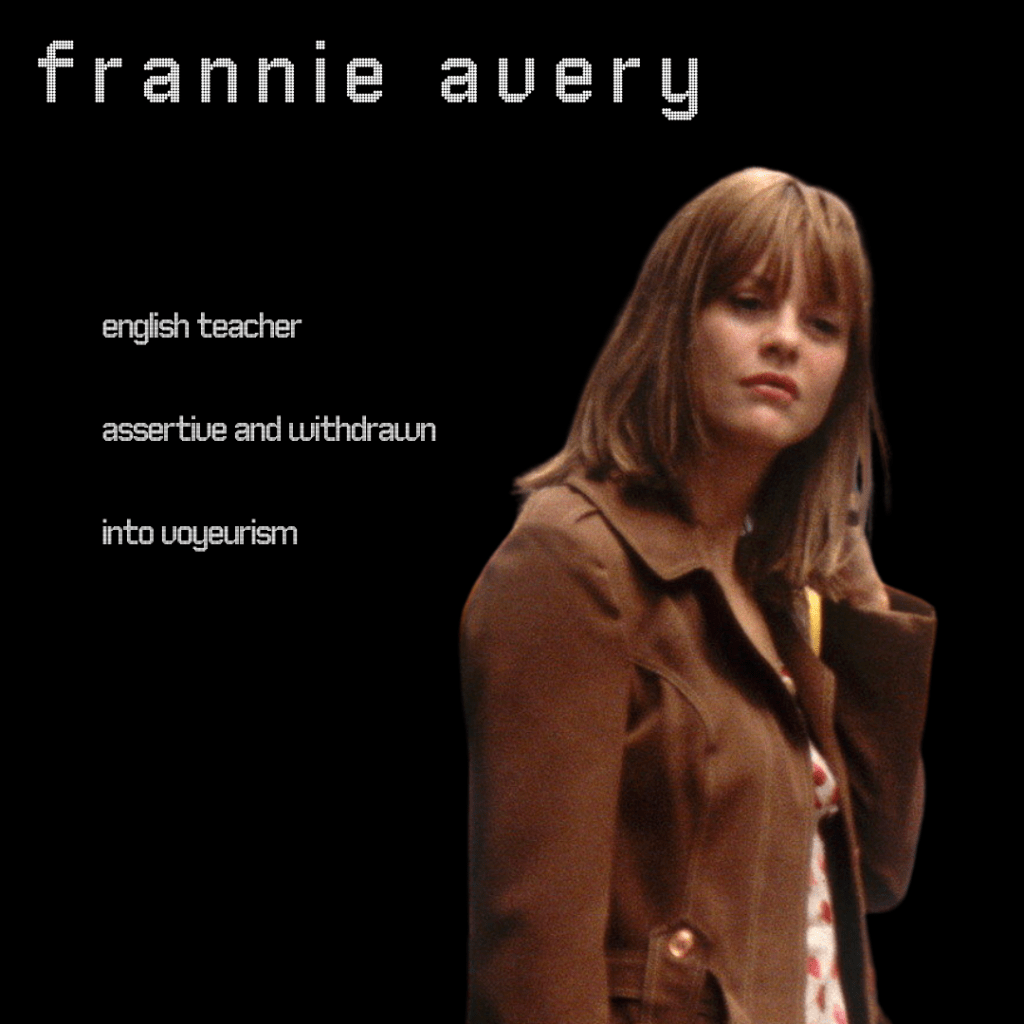
She actually discovered her taste for voyeurism en route to the bathroom. She was searching the basement corridors of a dive bar, when, by a quirk of fate, she found a man. And a woman on her knees. She couldn’t see much but blue acrylics on his ——, his hand in the woman’s hair, and tattooed on his wrist: the three of spades.
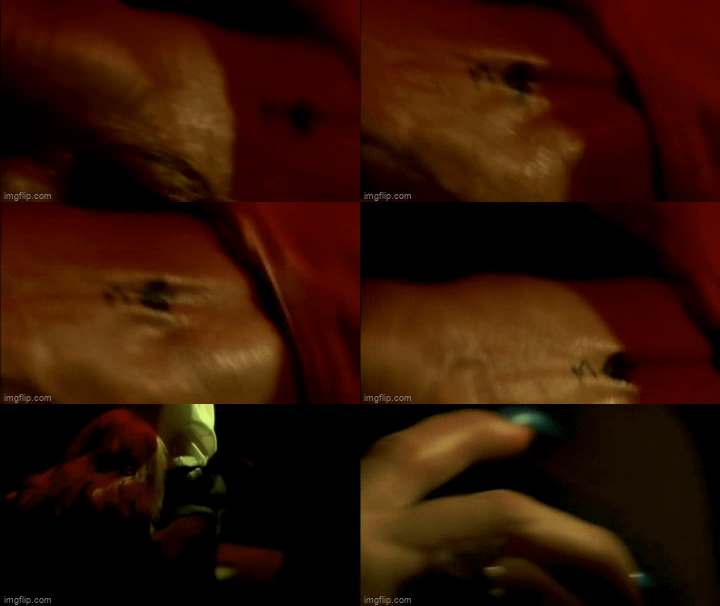
Later, Mark Ruffalo appears in the stairway of her apartment building and introduces himself as Detective Malloy. NYPD.
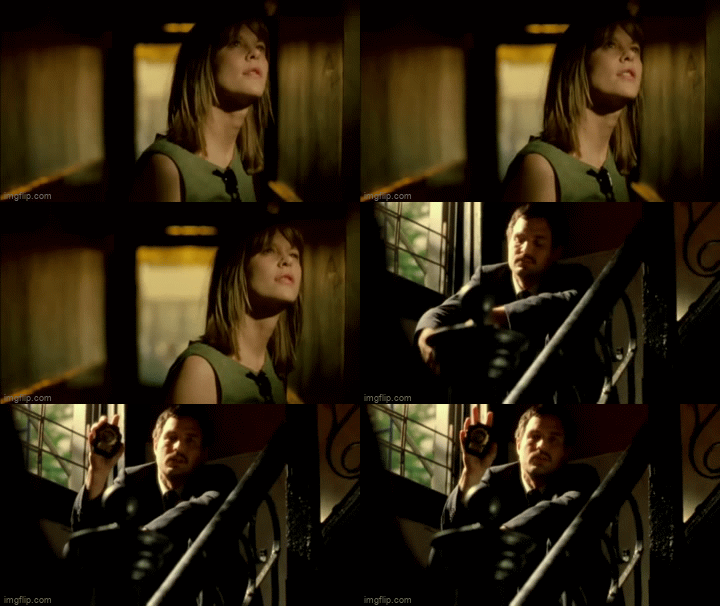
A woman with blue nails was murdered. Angela Sands. Her head was found in the community garden of Frannie’s building. Malloy lurks around her home, allegedly in pursuit of a witness account. He asks her about the tiny articles of paper scattered along the walls of her apartment so she explains that she collects words and poetry.
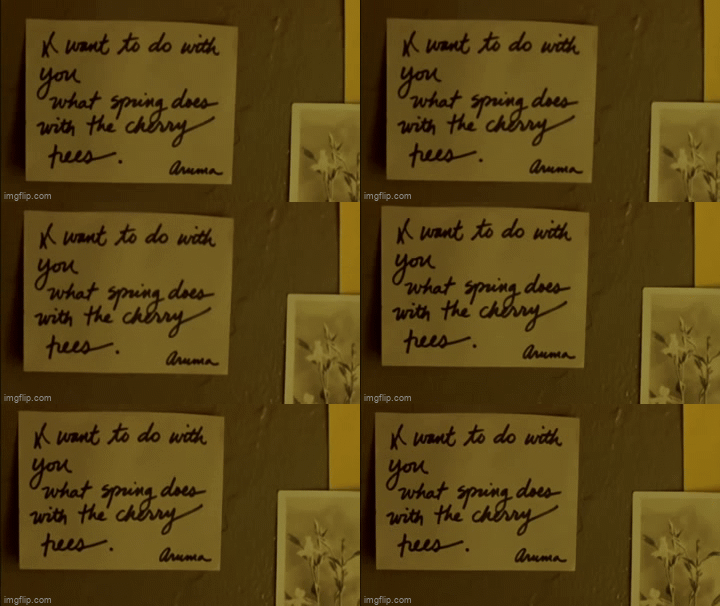
She asks him how Angela Sands was murdered and he gives her the word of the day- DISARTICULATED
In this context, to disarticulate is to separate the bones at the joints. Alternatively, it means to break up or disrupt someone’s logic. The dual sense of potential horror for women who date men.
As Malloy continues prodding at her private life, Frannie moves, unconsciously, to shield herself behind a string of fengshui good luck coins. Her mind digresses, lustfully and in tandem she sees a three of spades tattoo on his wrist – exactly like the one from the other night. Malloy makes no effort to hide it, he sort of calls attention to it. He repeatedly teases her memory, “Do I know you from some place?” prompting her once more from halfway out the door. I always loved how transparent Malloy is here, because sometimes it’s the clarity of a situation that can be disorienting. You think, there’s no way someone is playing in your face so there must be something you’re missing. It’s sort of ridiculous how effective this is.
Once he’s gone, she pins his business card to the wall, his name displayed within her shrine of dismembered thoughts and ideas.
That night, Frannie masturbates to the idea of Malloy and even places him in the salacious prelude to Angela Sand’s murder. Fantasy plays an interesting role in survival, in the short term, it can help us endure situations we normally couldn’t. Like being pursued by a woman killer. Pauline Richards makes a really interesting note about the problem of fantasy –
“…the repression is the problem isn’t it? The disconnection from the past, which of course, still exists.
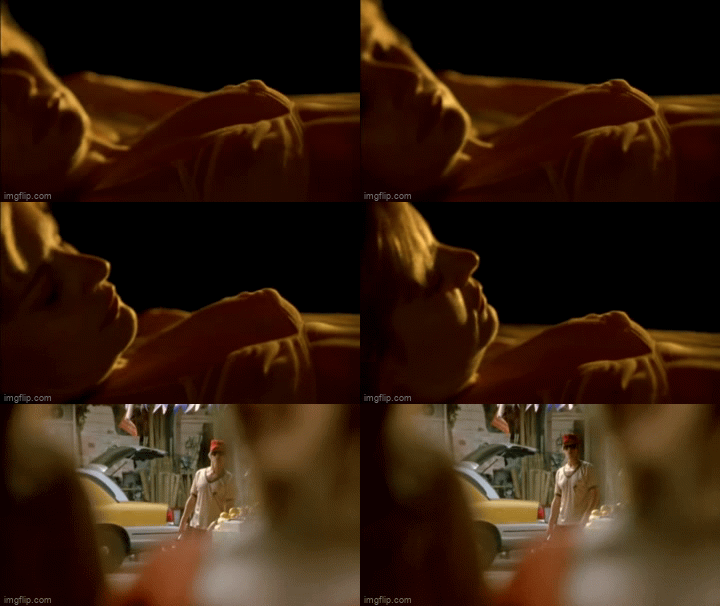
It may no longer be in conscious awareness but it will still be represented in an informational state in some other form. The fantasy really is a transitional state between states. Between the past and some future adaptation that no doubt would be better for that person”
Mythologizing is sometimes part of adapting to new situations. It’s in the process of knowing. When it comes to relationships, until we’ve done the legwork, everything we think we know about ourselves, our boundaries, other people – is mostly theory. You can read all the books, live vicariously through whoever and command all the good advice to memory if you like. Anything a person truly knows is reflected in their life. The peaks and valleys of human connection demand to be known not just intellectually, but experientially.
Fantasy is an exercise bicycle for the mind. It might not take you anywhere, but it tones up the muscles that can. – Terry Pratchett
I think to discover the truth, you must first explore the delusion. That requires a level of bravery and openness that is often reserved for the inexperienced. It’s why in hindsight, many of us can’t fathom what we’ve done, believed, allowed.
Frannie’s in-attentional blindness and social curiosity will bring her life to the shores of climax. She’ll have a near death experience and be reborn into greater awareness. It’s not for the faint of heart, to be disarticulated, but I’d argue it’s far worse to never have your logic disrupted.
If you ever feel shame for your dumb decisions in love/sex, I hope you never change your heart but but just your mind, remember what Frannie told her sister:
“You’re not a freak. I admire you, you live out of your own unconscious. You’re a poet of love. ‘The lovelorn man. Who, sick in soul, and of this busy human heart a weary. Worships the spirit of unconscious life. In tree or wild flower, a gentle lunatic “
The next morning, after indulging her carnal fantasies, Frannie feeds an alley cat. They always tell you curiosity kills the cat, they never tell you satisfaction brought it back!


Leave a Reply